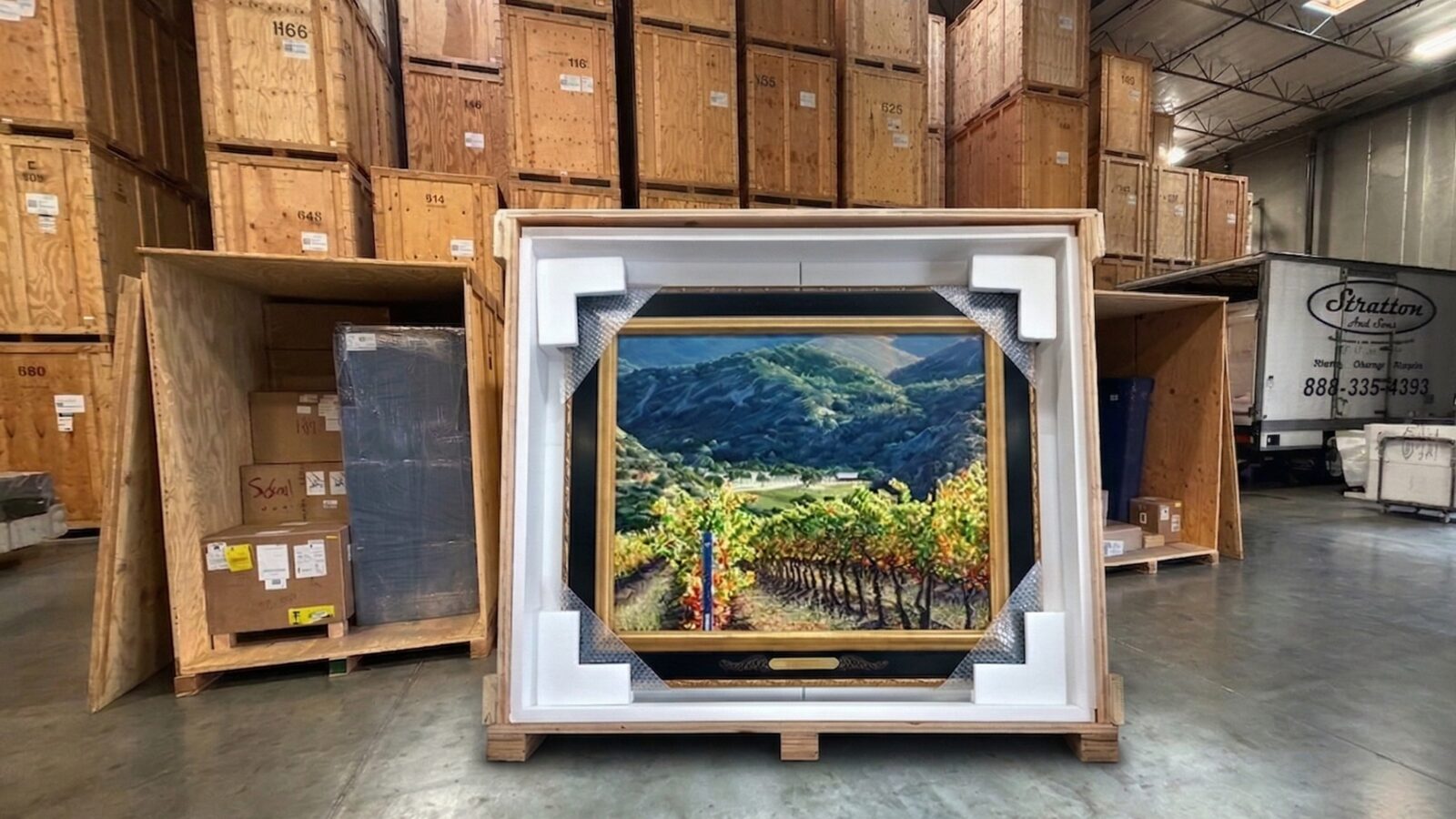
A valuable painting, a period sideboard, or an heirloom sculpture is not just heavier or more expensive than an ordinary box — it fails in completely different ways. Ordinary household items survive a bump. Fine art and antiques are damaged by things you cannot see happening: a few degrees of humidity swing, sustained road vibration, the pressure of a strap in the wrong place, or a fingertip on a varnished surface.
After more than fifty years of moving art for galleries, museums, designers, and private collectors across Los Angeles, we have learned that almost every damaged piece was lost to a small number of avoidable mistakes. This guide walks through how professionals actually protect valuable objects — what to do before anything is packed, the materials and techniques that matter, when a custom crate is genuinely necessary, and how transport, climate, and insurance fit together.
Key takeaways
- Document condition with dated photos before anything is touched — it protects both the piece and your insurance claim.
- Never let packing materials touch a painted or varnished surface directly; face it with glassine or acid-free tissue first.
- The three silent killers of art in transit are humidity swings, sustained vibration, and point pressure — all are preventable.
- A custom crate is warranted for anything high-value, fragile, irreplaceable, or traveling long distance; padded blanket-wrap is fine for many robust pieces.
- Air-ride suspension and climate control matter far more than most people expect, especially for canvases, veneers, and glued antique joints.
- “Fully insured” on a mover’s license is not the same as valuation coverage on your specific piece — confirm the numbers in writing.
Why fine art and antiques need a different approach
Standard moving protects against impact — dropping, crushing, jostling. High-value pieces need protection against a wider and subtler set of forces. A canvas can slacken and crack from a humidity change alone. Antique veneers and glued joints, some over a century old, loosen when the air dries out in transit or storage. Gilded frames chip if anything presses on the ornament. Varnish and painted surfaces bruise from contact with the very materials meant to cushion them.
The goal of professional art handling is not simply to prevent the piece from being dropped. It is to keep the object in a stable environment, isolate it from vibration, and ensure that nothing ever touches a vulnerable surface. Every technique below serves one of those three aims.
Before you pack: document, measure, and appraise
The most important work happens before a single wrap goes on. Skipping this step is the single most common mistake we see, and it is the one that costs collectors the most when something does go wrong.
- Photograph each piece in detail — overall shots plus close-ups of corners, existing chips, craquelure, joins, and any prior repairs. Date the photos. This is your condition report and the backbone of any future insurance claim.
- Measure height, width, and depth including the frame, base, or any protruding elements. These numbers determine crate sizes, truck access, and whether a piece will clear doorways, elevators, and stairwells.
- Confirm current appraised or replacement values for anything significant. Valuation coverage is based on documented value — an undocumented piece is difficult to claim at its true worth.
- Note any piece that is already fragile, previously restored, or structurally compromised, and flag it to your movers in advance so it can be handled accordingly.
Do not clean or “touch up” before a move
Well-meant cleaning is a frequent source of damage. Dusting a fragile gilt frame, wiping a painting, or polishing an antique can lift flakes or strip patina. Photograph the piece as-is and leave conservation to a conservator.
The materials that actually protect valuable pieces
The order in which materials touch an object matters as much as the materials themselves. The layer against the artwork must always be inert and non-abrasive; cushioning and rigidity come after.
- Glassine or acid-free tissue is the first layer against any painted, varnished, gilded, or porous surface. It will not stick, transfer, or react.
- Never place bubble wrap, plastic sheeting, or newsprint directly against art. Plastic traps moisture and can imprint or adhere to a surface; newsprint transfers ink.
- Foam corner protectors guard frame corners, which take the most abuse.
- Rigid backing — acid-free board or a purpose-built face panel — protects the canvas plane of an unglazed painting.
- Painter’s tape belongs on the glass of a glazed piece (in an X pattern to contain shards if it breaks), never on the artwork, frame, or finish.
Packing paintings and framed art
Framed and canvas works are the pieces most often damaged by amateur packing, usually because something was pressed against the surface or the piece was laid flat.
- Face the front with glassine or acid-free tissue, then protect all four corners with foam protectors.
- For glazed (glass or acrylic) pieces, tape the glazing in an X so a break cannot slide into the artwork — tape the glass only, never the frame or art.
- Add a rigid face panel or backing so nothing can press into the canvas plane.
- Wrap the assembled package and, for anything valuable or traveling any distance, place it in a custom crate or a purpose-built art box rather than a generic carton.
- Always transport paintings on edge, never flat. A flat canvas flexes and “drums” with every road vibration, which is exactly what causes cracking.
Sculptures, ceramics, and three-dimensional pieces
Three-dimensional objects are about balance and stress points. The weak spots are the thin, projecting, or narrow-based elements — an outstretched arm, a delicate finial, a top-heavy vase on a small foot.
- Support the object at its strongest points, never by a projecting or delicate element.
- Immobilize it completely inside its container. Movement is the enemy; a piece that can shift will eventually strike its container wall.
- Fragile projections are individually padded and, where needed, braced so road vibration cannot work them loose.
- Heavy, dense, or top-heavy pieces are cradled in a custom-built crate with internal bracing tailored to the object’s shape and center of gravity.
Antique furniture: what makes it fragile
Antique furniture looks robust and is often the opposite. Century-old glue, hand-cut joinery, thin veneers, and applied ornament all behave differently from modern furniture, and they respond badly to being handled like it.
- Remove or immobilize loose parts — drawers, shelves, marble tops, glass doors — and pad and transport them separately.
- Never lift a piece by a part that was not designed to bear weight: not by the arms of a chair, the top of a table, or a decorative element.
- Pad-wrap the entire piece in clean moving blankets over a protective inner layer so buckles, hardware, and edges never contact the finish.
- Protect delicate veneer and marquetry from pressure and from the humidity swings that lift and crack it.
- Marble and stone tops travel on edge and are crated when valuable — they snap under their own weight when carried flat.
When you need a custom crate (and when you don’t)
Not everything needs a crate, and being told everything does is a sign of a padded invoice. The honest test is the nature of the piece and the journey.
A custom crate is genuinely warranted when a piece is high in value, structurally fragile, irreplaceable, unusually shaped, or traveling a long distance, into storage, or by air or sea. A crate built to the exact dimensions of the object — with internal bracing and the right lining — isolates it from impact, pressure, and handling in a way no amount of blanket-wrap can match. For international shipments, crates must also meet ISPM-15 standards for treated wood.
For many robust pieces on a short local move, professional pad-wrapping and careful placement in an air-ride truck are entirely appropriate. The skill is knowing which is which. We build crates in our own Chatsworth workshop rather than outsourcing them, so the crate is made to the piece rather than the piece forced into a stock box.
Ask to see the reasoning
A trustworthy fine-art mover will explain exactly why a given piece does or does not need a crate. If every item is quoted for a custom crate without explanation, ask why — the answer tells you a lot.
Transport, climate, and storage
Once a piece is packed, the two remaining threats are vibration and environment — and they act over the whole journey, not just at the moments of lifting.
- Air-ride suspension trucks cushion the constant road vibration that fatigues canvases, loosens veneers, and stresses glued joints. On Los Angeles freeways and canyon roads, this matters more than most people expect.
- Climate matters: extreme heat and humidity swings are as damaging as any impact. A canvas left in a hot truck or a piece stored in an uncontrolled unit can be harmed without ever being dropped.
- For anything sensitive going into storage, climate-controlled space with stable temperature and humidity is the standard, along with secure, monitored, inventory-tracked facilities.
- Pieces should be secured individually in the vehicle so they cannot shift, lean, or contact one another in transit.
Insurance and valuation: what “covered” really means
This is where collectors are most often caught out. A mover being “licensed and insured” refers to the carrier’s own legal coverage. It is not the same as the valuation coverage that would actually reimburse you for a damaged painting.
Basic released-value protection is typically calculated by weight — a tiny fraction of what a valuable artwork is worth. Full-value or declared-value protection covers a piece at its documented value, which is exactly why the appraisals and dated condition photos from the start of this guide matter. Confirm which type of coverage applies to your specific pieces, in writing, before the move.
Match coverage to value
For a high-value collection, ask specifically how each piece is valued for coverage and whether declared-value or third-party fine-art insurance is appropriate. “It’s covered” is not a number.
When to call a professional fine-art mover
Plenty of everyday items you can pack yourself. But some pieces justify a specialist from the outset — and recognizing them early is what prevents an irreversible loss.
- Anything of significant monetary, artistic, or sentimental value that cannot be replaced.
- Large, heavy, awkward, or top-heavy pieces — oversized canvases, stone sculpture, grand mirrors, marble-topped furniture.
- Objects that need a custom crate, climate control, or long-distance, air, or sea transport.
- Whole-collection moves, estate contents, or gallery and museum-grade work where the stakes are simply too high to improvise.
A specialist brings the crating, materials, air-ride transport, climate-controlled storage, and — just as importantly — the judgment about which piece needs which level of protection. For fifty years that judgment is what galleries, designers, and collectors across Los Angeles have relied on us for.
How Stratton & Sons can help
The services behind everything in this guide — handled by our own crews and crating shop.
Fine Art Handling
Museum-quality care with in-house crating, air-ride transport, and climate-controlled storage available.
Custom Crating & Shipping
ISPM-15 compliant crates built to each piece in our Chatsworth workshop — local to international.
Storage Solutions
Secure, 24/7-monitored Chatsworth warehouse with climate-controlled space available for specialty items.
Estate Moving
Discreet, full-estate handling of fine art, antiques, and heirlooms with detailed inventories.
Moving art, antiques, or a full collection?
Talk to a fourth-generation Los Angeles fine-art mover about crating, transport, and storage for your pieces. Free, no-obligation estimates.